
“Magnetic flux always follows the path of least resistance”
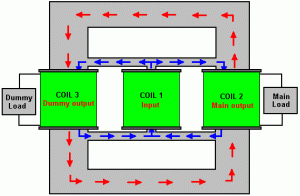
PDI (Potential Difference Inc. / Thane Heins) took a three-phase transformer and placed the primary in the center with the two secondaries at each side, then added an outer toroid which connected the two secondaries to each other, but bypassed the primary. Now the primary delivers flux to both the secondaries but the secondary induced BEMF flux cannot couple back to the primary.
Instead, the secondary induced flux follows the lower reluctance flux path route and couples to the other adjacent secondary while providing the flux required to maintain the voltage across the load.
The Bi-Toroid Transformer (BiTT) operates as a magnetic diode, consumes almost pure reactive power while delivering real power to the loads, and only allows the transfer of energy in one direction. Because the BiTT primary is isolated from the secondary on-load induced flux, the BiTT primary power factor and current do not change from no-load to on-load.
With a purely resistive load on the BiTT primary, power factor is virtually zero and the efficiency of the energy transfer is increased accordingly. If for example, the transformer primary power factor is reduced by 30%, the transformer efficiency is also increased by 30%.
This transformer can also be applied in chargers and in electric vehicles between the generator and the batteries, and between the batteries and the motor. – Thane Heins
Conventional 3-Phase Transformer Construction 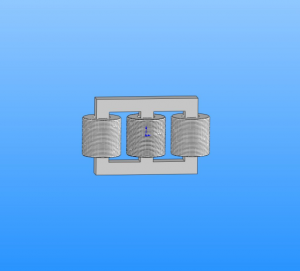
Bi-Toroid Transformer Construction
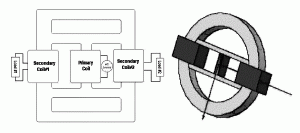
Bi-Toroid Connections Diagram
Whenever power is generated in the QEG core using parametric resonance, the current lags the voltage, so the power within the respective tank circuit is mostly VARs (reactive power). When resonating the primary only, the secondary voltage and current will be in phase, and conversely, when resonating only the secondary, the primary voltage and current will be in phase, so in the case of resonating only one winding, the core converts the VARs in the resonant tank to real power (in the non-resonant winding).
If you are experimenting with resonating both the QEG primary and the secondary together, several things change –
- We now have only VARs in the core (mostly, since power factor is non-zero).
- When tuned, both primary and secondary frequencies match up, at roughly double the frequency of either winding resonated alone (the parametric pumping frequency).
- When properly tuned (by adjusting primary and secondary capacitor and inductor values), the power in the output windings (VARs) is increased, while significantly reducing the input power.
The Bi-Toroid Transformer (BiTT) could be used to recover the energy in the secondary by connecting directly in the secondary loop where the BiTT primary inductance would be included in the secondary loop resonant tuning. This unique transformer consumes VARs while providing real power (Watts) to the load, with no reflection to its primary (no disturbance to the QEG resonant frequency/RPM).
The BiTT can be employed in any experiments where conversion from reactive to real power is a requirement, and isolation of the load from the source is desirable. We have a couple of members of the Free Energy Academy who are currently experimenting with the Bi-Toroid in the QEG secondary loop. Work is ongoing, and we have heard that one member is up to the range of 9,000 VARs resonating the primary and secondary together. The hope is that enough of that reactive power can be converted to real power to self-loop the machine with power left over to drive additional loads.
– J.R